This painting was exhibited in the part of the gallery that focused on the work of Nicolas Folland. The exhibition was titled maritime encounters and it was chillingly beautiful, pre loved crystal glass ware had been transformed into icy references.
As you wander deeper into the dark gallery space this painting appears. It stands out in the exhibition and provides a contrast to the room the comprises mostly of sculptural works. This oil painting was created in ....
I find it strangely comforting
I gain a sense of strength in this comfort also. This comfort is born from the narrative I perceive.
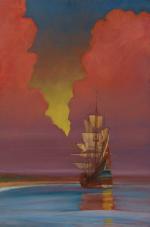
The elements of this painting
the ocean
the wave
the ship
the moody sky
the direction of the ship
a stillness
I kind of imagine if this were playing out in reality it would be occuring in slow motion and the wave would not incur the ravished sounds of the ocean it would be moving silently and elegantly, simply a course of motion in which the ship will have to succumb to.
Whilst projecting my own feelings onto this situation I came up with the idea that it reminded me a bit of dealing with anxieties. I began to read this image feeding off this thought. I started painting a picture of my own.
The overwhelming wave is an expression of what is out of our control. In this situation it is looming, and telling the ship that in its presence it is simply insignificant. In response to the inevitable situation the ship has encountered, it squares to the looming wave, facing right into the heart of it.
This connection between the ship and the wave stands out, it is what I am immediately drawn to. Looking further into the image a small patch of blue sky appears in the brooding reddish sky. This small opening in the sky allows a beam of light to fall upon the ship. So there is this shining, hopeless ship facing an incomprehensible wave and instead of it inducing an unsettling feeling I find comfort in this narrative. I find comfort knowing that someone has constructed this painting, to show that one way of dealing with elements out of our control is to front up to them and accept it. It is comforting as this is a message I need to tell myself. Most likely I constructed this message just so I could tell myself.
I can quite easily get caught up in anxiety, my most common anxiety is not knowing what the future holds and I hate that I can get caught up in worrying. It feels like it is eating me sometimes! But I connected to the element of nature in this painting. This wave is happening and much like time, it will unfold and become a moment, a moment that will inscribe its presence in history and become a lament to the unpredictable nature of life.
Artists who use the idea of uncertainty.
Originally, Romantic also meant the opposite of classical. Classical is calm, orderly, even serene, like the Venus de Milo. Romantic is wild — a painting or poem bursting at the seams with energy, meaning, and often intimations of something spiritual
Following these guidelines of Romantic tendencies I believe that Ian North’s painting expresses deep intense emotions. The idea of facing the wave is uplifting, I felt comforted by the fact that another person was expressing facing things out of your control.


RESEARCHING THE WAVE
What have others said on his work - article
There is not a huge deal of information about this paintings so I did email, however, I will obviously do my own research. An article written by Adam Geczy is really informative, it does not address the work 'The Wave' explicitly, it does give an insight into similar works produced by Ian North. The article is titled Sail Away and was written in 2009, only five years after the painting of the wave.
Geczy refers to Norths "suite of sea and boat paintings" and the image accompanying the article can be easily related to the wave.
Geczy draws our attention to the traditional sense of this contemporary painting, likening the sea and boat paintings to works created by the Romantic American Thomas Cole, Turner and the eighteenth century French marine painter Loutherbourg.
Romanticism
Romanticism
Finding Romantic tendencies.
- Romantic artists didn't have one style like the Impressionists or Expressionists.
- The movement was about intense personal expression
- Spread across most of Europe and later to the United States.
- Romanticism wasn't merely a visual-arts movement — it included poetry, fiction, and music.
It doesn't refer to romance at all. It means being a staunch individualist, believing in the rights of other individuals, and expressing deep, intense, and often uplifting emotions
The Romantic period was the first time in history that art focused on teaching people to care about each other. Romantic artists were also concerned with promoting individual liberty, ending slavery, and supporting democratic and independence movements, like the Greek war for independence from Turkey and the nationalism movement in Italy.
The French painter Delacroix used his paintbrush to win support for the Greek struggle for independence against the Turkish Empire. His painting The Massacre at Chios broadcast the terrible price the Greeks were paying in their struggle for liberty (in 1822, the Turks massacred 42,000 inhabitants of the island of Chios and sold about 50,000 as slaves in North Africa), moving many Europeans to sympathize with the Greek cause.
Many Romantics believed that there was a basic goodness in man buried under layers of socialization. The idea was largely born in the brain of Jean-Jacques Rousseau. In his influential book The Social Contract, he wrote, "Man is born free, and everywhere he is in chains."
Originally, Romantic also meant the opposite of classical. Classical is calm, orderly, even serene, like the Venus de Milo. Romantic is wild — a painting or poem bursting at the seams with energy, meaning, and often intimations of something spiritual
Following these guidelines of Romantic tendencies I believe that Ian North’s painting expresses deep intense emotions. The idea of facing the wave is uplifting, I felt comforted by the fact that another person was expressing facing things out of your control.
It has been suggested that Romantic artists tend to cast an object as a surrogate for themselves – a boat for Turner, a tree for Friedrich – in order to express the ways in which the inexorable energies of nature and oblivion advance upon the frail self.
It was customary for Romantic artists to cast an object as a surrogate for themselves – a boat for Turner, a tree for Friedrich – in order to express the ways in which the inexorable energies of nature and oblivion advance upon the frail self.
https://www.artlink.com.au/articles/3300/sail-away-ian-north/
No comments:
Post a Comment