Where has this year gone? - most asked question of December am i rite.
I had a brainwave and realised that I haven't been doing something that is VERY important for my process. Which is documenting and writing. Words cement my thoughts. Without my written words I am in a constant fleeting direction! Oh alphabetical sequences how you keep me sane.
In order of how I want my thoughts to go:
1. Use the Camera from Belf!
2. Create a concept to begin a series of works - I feel like they want to be paintings. Maybe they could grow from the photos
3. Volunteer at places you might like to spend you future. galleries, museums, artlab, desart
4. Go to shows with Uni frunds.
5. Observe. Interpret. Record
In starting using the camera I want to think about what is inspiring me at the moment and what is driving my brainy modules.
WARNING PERSONAL RANT - I want to feel connected to the world. I want to understand how it works and why. I am curious about the nature of everything, from the level of the atom to the level of the biosphere and everything in between. I want to learn. I believe that I can cement my knowledge through my practice. My practice is a process. Which I am still discovering.
I will organise each post as a project. the post will be constantly updated as the project develops it will include research, ideas, responses and outcomes.
In response to Ian North’s painting The Wave I have created a work titled Facing Waves, it is a performance based video. I
involved myself in The Wave entirely
and in doing so found myself acting out being submerged by a wave. In shaping
and resolving the ideas for this work I have drawn upon several aspects of The
Wave and transformed these elements by adding my own perspective.
Upon first gaze of The Wave I was captured by the scene that
played out on the canvas. The canvas is a panorama dimension, in which an
enormous wave occupies a space stretching between the left to the right, its
presence is pervasive. What was noticed secondly was a ship, appearing
insignificant in the presence of the wave. The combination of these two images
could be read as the futility of man in the presence of nature. However, I
began to question more thoroughly as I realised that the ship was facing
towards the wave, it changed the feel of the painting completely. Suddenly I
was struck by this scenario in which this small ship is facing the enormous
wave, this calm encouraging sense spread through me as I realised that this
ship is going head on into what is out of its control. This idea filled me with
courage.
I began to think about the waves in my own life. The biggest
wave I am challenged with comes from a personal place, I have a tendency to
create anxieties about the future. I realised that whilst looking at The Wave I
was imagining myself as the ship and facing a wave of my own. This sparked the
idea of a work that involved myself emulating this situation. I explored ways
of which I might be able to simulate this and I resolved upon a performance
based work.
The use of a mirror allowed me to record facing myself, with
the camera positioned behind me I am viewed in the first instance from behind
and in the second instance in the reflection of the mirror – emulating the
position of the ship and the wave. I intended to reference the dimension of the
canvas by using the same dimensions for the video. In making a video I
transform the The Wave from its two dimensional sense into a performance work
by enacting out the situation.
In acting out this scenario I suggest that I have been
engulfed by the wave, to do this I cover my body in paint - I tried to match
the colour of the body paint to the colour palette of the painting. In the
video I avoid showing the whole process of covering my body as it is time
consuming, so I show a small fraction of this. The next part of the video
involves me taking a step back away from the mirror, this felt quite bizarre
for me as I fell into staring at my own reflection. The longer I stood staring,
the deeper I found myself in contemplation of my anxieties and where they come
from, why I have them and what their impact is, the disadvantages of them and
the advantages of them. I just stood there thinking and the performance began
to really take a path of its own. I did not come to any conclusion about the
future or life but it felt really good just to stop and think and be comforted
in the idea of facing something head on.
In the previous steps of the project I have explained how Ian Norths painting made me feel. Now comes the part where I get to use these ideas I have taken, transform them and add myself to create a new work. In thinking about how I was going to do this I had to thoroughly look at the elements of Norths painting and how it made me feel and then I could reinterpret that from my own perspective. So in a way I have taken the principles of his work and applied it into the personal.
The wave can be a symbol that represents the futility of man in the face of nature, but the ship is facing the wave, it is accepting what is going to happen, it is facing its fear. Then there is a ray of light that shines down onto the ship that gives an inkling of courage to the viewer. Who knows maybe humanity has a chance?
I felt strongly about the connection between the ship and the wave, the fact that the ship was facing the wave created this huge dialogue of possibilities. In my performance based work I wanted to emulate this confronting aspect. So I devised the idea of a mirror to show that I am both the ship and the wave. I am facing the fears I construct. My biggest barrier is myself, this is what this is about,
I used the landscape formatting to emulate the scope of the painting. Then I positioned myself in front of the camera so that I was visible from two different angles, showing that I was facing myself - I am the ship and I am the wave. I tried to use the colour palette of the 'The Wave' as another reference to the idea that I am being engulfed by the wave but I am still the ship, I am enduring my fears and it becomes a part of me.
I did record myself washing off the paint, in the same positioning as the rest of the videoing shown but to be honest it was just too much. I realised that one aspect of the painting that makes it so powerful is its stillness. So I finish the video in a very reflective space - which I like.
This speedy video shows the process of me getting all messy in body paint. This was a really important part of the work on a personal level, but I chose to exclude the whole process of it from the final video work as it was a lengthy procedure that was difficult to edit in well. I did experiment with including this body painting element but it didn't really do too much and I also left that jug of water in the way - annoying! So I thought that I would show myself adding more paint to my already covered body to show that I did it myself.
After sequencing the video I played with the sound aspect. I really wanted to include my voice, it just felt important to add. I toyed with the idea of writing some poetry about facing fears, so I came up with some phrases to add in at different points but I found that the words really took away from the imagery. I think that the addition of words created too much work to read at one time, it didn't leave enough space to think for yourself whilst viewing it.
Then I experimented with ocean sounds, I was trying to use varying ocean sounds to emulate the experience of being taken under and then surfacing again. But I think it was just a bit tacky! I used some different ocean soundtracks from youtube and the video began with gentle ocean lapping sounds and then when I am covered in paint I am pulled below the surface and the sound is underwater bubbling, then towards the end the lapping sound reappears and the underwater bubbling fades out. It was just lame though, I don't even know how to explain why it didn't work but it was just bad!
So I included a couple of small phrases at the start of the video to introduce it in a way.
This is the time I painted myself blue for an assignment
It didn't come out too easily
The final video only has a small voice over element and I'm really happy with it. It's kind of unusual, the performance really took a path of its own - it was an exciting thing to try. I do feel slightly vulnerable showing this video to people, but that's just the nature of the performance I chose to do.
I thought that the series of works in response to Bas Jan Ader's 'searching for a miracle' was really interesting and moving. There was a breadth of responses and I was intrigued to see the individuality in each response. I found it comforting to see that each account was special in its own way, sometime I get easily caught up in the right way to do things according to a marking scheme or according to what will please another person, but these responses reminded me of the importance of your own voice.
A small bit on Bas
1942 - 1975
Dutch/Californian artist
conceptual/performance
last seen in 1975
took off in what would have been the smallest sailboat ever to cross the Atlantic, a work titled In Search of the Miraculous.
left behind a small oeuvre, often using gravity as a medium
The Homages Begin
David Horvitz - I'll meet you here
http://vimeo.com/1279364
This is the video conception of I'll Meet You Here in which an arrow hovers on the horizon
Claire Fontaine
Please Come Back, 2011
An interesting comment regarding 'appropriation' - "she refuses the qualification of “appropriationist”, preferring the one of “expropriationist” that insists on the use value of the borrowed references, and on the political meaning of theft."
It's a bit confusing as to whether this work was created as a homage to Bas Jan Ader or not!
Ahmet Ogut, Guppy 13 vs Ocean Wave
Guppy 13 vs Ocean Wave; a Bas Jan Ader Experience
Guppy 13 is the exact same model as Dutch artist Bas Jan Ader’s boat ‘Ocean Wave’
Bas Jan Ader's boat, 'Ocean Wave,' was found unmanned and partially submerged 150 miles off the coast of Ireland by a Spanish fishing vessel in 1976. It was taken to La Coruña, Spain for investigation. A few weeks later, the boat was stolen and it was never found.
"I found the same type of sailboat that Ader used, a Guppy 13, I bought it and got it shipped to Amsterdam. I invited visitors to live through Bas Jan Ader's experience, albeit it only for a few minutes, in this sailboat on Amsterdam's waters. The only rule was that everybody had to get on the sailboat by themselves. So, I recreated exactly the same physical conditions of Bas Jan Ader's experience. In the video, we see a fictional documentary, in which Guppy 13 sails backwards to start from the end of its uncompleted journey. When we look closely, we notice that the single passenger on Guppy 13 is constantly changing. The music we listen to while watching the video is a Henry Russell composition playing backwards, which was part of Bas Jan Ader's last project. In a way, it is the documentary of a journey backwards in time." - Ahmet Ogut.
TIME LINE
7th of May 2010
Guppy 13, purchased from Zakry Standerfer and shipped from USA, arrived to the Netherlands.
28th of June 2010
Guppy 13 was stolen in Amsterdam waters.
16th of October 2010
After 4 months, Guppy 13 was found on Lijnbaansgracht, Amsterdam
Analyse closely why that piece prompts the
response it does in you – what specific qualities in that work affect
you and how are they conveyed in the work, what devices, techniques, strategies
does the artist use to give the work its’ power. Compare it to other similar
works; what is unique to your selected work. We will be looking for 5-6 pages
minimum in your studio diary of research/analysis into your selected work. The
selection, research, analysis component of the project needs to be completed
and production of the work begun in
This painting was exhibited in the part of the gallery that focused on the work of Nicolas Folland. The exhibition was titled maritime encounters and it was chillingly beautiful, pre loved crystal glass ware had been transformed into icy references.
As you wander deeper into the dark gallery space this painting appears. It stands out in the exhibition and provides a contrast to the room the comprises mostly of sculptural works. This oil painting was created in ....
I find it strangely comforting
I gain a sense of strength in this comfort also. This comfort is born from the narrative I perceive.
The elements of this painting
the ocean
the wave
the ship
the moody sky
the direction of the ship
a stillness
I kind of imagine if this were playing out in reality it would be occuring in slow motion and the wave would not incur the ravished sounds of the ocean it would be moving silently and elegantly, simply a course of motion in which the ship will have to succumb to.
Whilst projecting my own feelings onto this situation I came up with the idea that it reminded me a bit of dealing with anxieties. I began to read this image feeding off this thought. I started painting a picture of my own.
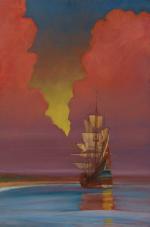
The overwhelming wave is an expression of what is out of our control. In this situation it is looming, and telling the ship that in its presence it is simply insignificant. In response to the inevitable situation the ship has encountered, it squares to the looming wave, facing right into the heart of it.
This connection between the ship and the wave stands out, it is what I am immediately drawn to. Looking further into the image a small patch of blue sky appears in the brooding reddish sky. This small opening in the sky allows a beam of light to fall upon the ship. So there is this shining, hopeless ship facing an incomprehensible wave and instead of it inducing an unsettling feeling I find comfort in this narrative. I find comfort knowing that someone has constructed this painting, to show that one way of dealing with elements out of our control is to front up to them and accept it. It is comforting as this is a message I need to tell myself. Most likely I constructed this message just so I could tell myself.
I can quite easily get caught up in anxiety, my most common anxiety is not knowing what the future holds and I hate that I can get caught up in worrying. It feels like it is eating me sometimes! But I connected to the element of nature in this painting. This wave is happening and much like time, it will unfold and become a moment, a moment that will inscribe its presence in history and become a lament to the unpredictable nature of life.
Artists who use the idea of uncertainty.
RESEARCHING THE WAVE
What have others said on his work - article
There is not a huge deal of information about this paintings so I did email, however, I will obviously do my own research. An article written by Adam Geczy is really informative, it does not address the work 'The Wave' explicitly, it does give an insight into similar works produced by Ian North. The article is titled Sail Away and was written in 2009, only five years after the painting of the wave.
Geczy refers to Norths "suite of sea and boat paintings" and the image accompanying the article can be easily related to the wave.
Geczy draws our attention to the traditional sense of this contemporary painting, likening the sea and boat paintings to works created by the Romantic American Thomas Cole, Turner and the eighteenth century French marine painter Loutherbourg.
Romanticism
Romanticism
Finding Romantic tendencies.
Romantic artists didn't have one style like the Impressionists or Expressionists.
The movement was about intense personal expression
Spread across most of Europe and later to the United States.
Romanticism wasn't merely a visual-arts movement — it included poetry, fiction, and music.
It doesn't refer to romance at all. It means being a staunch individualist, believing in the rights of other individuals, and expressing deep, intense, and often uplifting emotions
The Romantic period was the first time in history that art focused on teaching people to care about each other. Romantic artists were also concerned with promoting individual liberty, ending slavery, and supporting democratic and independence movements, like the Greek war for independence from Turkey and the nationalism movement in Italy.
The French painter Delacroix used his paintbrush to win support for the Greek struggle for independence against the Turkish Empire. His paintingThe Massacre at Chiosbroadcast the terrible price the Greeks were paying in their struggle for liberty (in 1822, the Turks massacred 42,000 inhabitants of the island of Chios and sold about 50,000 as slaves in North Africa), moving many Europeans to sympathize with the Greek cause.
Many Romantics believed that there was a basic goodness in man buried under layers of socialization. The idea was largely born in the brain of Jean-Jacques Rousseau. In his influential bookThe Social Contract,he wrote, "Man is born free, and everywhere he is in chains."
Originally,Romanticalso meant the opposite ofclassical. Classical is calm, orderly, even serene, like theVenus de Milo. Romantic is wild — a painting or poem bursting at the seams with energy, meaning, and often intimations of something spiritual
Following these guidelines of Romantic tendencies I believe that Ian North’s painting expresses deep intense emotions. The idea of facing the wave is uplifting, I felt comforted by the fact that another person was expressing facing things out of your control.
It has been suggested that Romantic artists tend to cast an object as a surrogate for themselves – a boat for Turner, a tree for Friedrich – in order to express the ways in which the inexorable energies of nature and oblivion advance upon the frail self.
It was customary for Romantic artists to cast an object as a surrogate for themselves – a boat for Turner, a tree for Friedrich – in order to express the ways in which the inexorable energies of nature and oblivion advance upon the frail self.
Research the
workextensively
- learn about the artist who made the work and/or the cultural context,
historical period the work is from, what especially was the motivation for the
work, why does it exist, why is this work significant enough to be chosen for
collection in AGSA, ask others for their response to the work.
The wave
2004, Adelaide
oil on linen
73.0 x 170.0 cm
WHO IS IAN NORTH?
Biography
b. 1945 Aotearoa, New Zealand
Director of the Manawatu Art Gallery, Aotearoa/New Zealand 1969-71
Curator of Paintings at the Art Gallery of South Australia 1971-80
Foundation Curator of Photography at the National Gallery of Australia 1980-84
‘coming out' as an artist in 1985
President rewriting the constitution to create the Art Association of Australia and New Zealand.
Head and (later) Professor of the South Australian School of Art (1984-1993)
Campaigned successfully for the return of the School to a CBD location
Established the Anne and Gordon Samstag Scholarship Program
Currently Adjunct Professor of Visual Arts, University of Adelaide
He has contributed a lot!
http://www.daao.org.au/bio/ian-north/biography/?
SELECTED
SOLO EXHIBITIONS
2013
Haven
2001,
Greenaway Art Gallery, Adelaide Felicia, South Australia
1973 - 78, Australian Centre for Photography, Sydney
2010
The
Adelaide
Suite, Greenaway Art Gallery, Adelaide Ian North Photographs 1974 -
2009,Art
Gallery of South Australia
2009
Sail
Away,
Greenaway Art Gallery, Adelaide
2006
Symptoms,Greenaway Art Gallery,
Adelaide
2005
Canberra
Suite & Canberra Coda (1980-81), Greenaway Art Gallery, Adelaide
2004
Sail
Away,
Apartment, Melbourne
1998
Vault(with Helen Fuller),
Experimental Art Foundation, Adelaide
1997
Correlations, Greenaway Art
Gallery, Adelaide
1992
Home
& Away,
Roslyn Oxley9 Gallery, Sydney
1990
Manifest
Destiny,
Roslyn Oxley9 Gallery, Sydney
1988
Pseudo
Panoramas, Cazneaux series, Roslyn Oxley9 Gallery, Sydney
1987
Seasons,
Pseudo Panoramas, Australia, Australian Centre for Photography, Sydney
The wave was painted in 2004 so Im going to connect it to the Sail Away 2004 exhibition.
I emailed him to ask about his painting - not sure if he will respond but I hope he does!
Pseudo panorama, Australia III (A view of the artist's house and garden in Mills Plain, Van Diemen's Land), 1987, Photograph/collage
Whilst sifting through the work of Ian North it becomes obvious that he has a strong connection to place, his work is predominantly landscape. The wave differs in how the landscape is constructed, much of his earlier photographs explore Australian outskirt urban environments. Then there is the move to painting landscapes, constructing naturalistic imagery that steers away from a natural representation - where the hand of the artist becomes more obvious.
THE WORK - THE WAVE
HISTORICAL CONTEXT
what were other artists focusing on in Adelaide in 2004
Australia 2004
10 years ago
I guess that was a time close to the start of the new millenium
Contemporary art scene
Traditional style painting
This work appeared in the THE EXTREME CLIMATE OF NICHOLAS FOLLAND exhibition - the work immediately has a context.
Other work in that exhibition.
The extreme climate of Nicholas Follandpresents key examples of Folland’s work, made over a ten year period, alongside works of art from the Gallery’s collection by Antony Hamilton, Frank Hurley, Narelle Jubelin, Nikolaus Lang, Charles-Alexandre Lesueur and Claude-Francois Fortier, Colonel William Light, Laith McGregor, Ian North, James Shaw, Benjamin Travers Solly and Sera Waters. These works, made predominantly in South Australia, offer a series of parallel tales about climatic extremes, the politics of place and the antipodean quest for adventure.
This exhibition had a very chilling effect.
Nicolas Folland.
Doldrum (installation view, Experimental Art Foundation) 2005
FORTIER, Claude-Francois, engraver France, 1775 - 1835
LESUEUR, after Charles-Alexandre France, 1778 - 1846
Nouvelle Hollande: Terre Napoleon
plate 5 from 'Voyage de découvertes aux Terres Australes'... (Voyage of discovery to Southern lands ...)
1800-04, published 1807, Paris
engraving , hand coloured on paper
24.0 x 31.2 cm (plate)
South Australian Government Grant 1968
Art Gallery of South Australia, Adelaide
SHAW, James
Australia, 1815 - 1881
The drifting wreck
1878, Adelaide
oil on canvas
43.0 x 54.0 cm
MOTIVATION FOR WORK?
WHY DOES IT EXIST?
WHY WAS IT SIGNIFICANT ENOUGH TO BE IN THE GALLERY?
The selection of this painting for such a specific exhibition gives us an insight into the reasoning for its presence here. The exhibition displayed works of that tell tales of "climatic extremes, the politics of place and the antipodean quest for adventure". I believe that The Wave moves through all of these ideas. The wave itself is the climatic extreme. Humanity in the face of nature questions our politics of place and our relationships and affinities with the environment. The connection between the wave and the ship is does not speak so much of a literal antipodean adventure, but more of an emotional adventure. As The Wave was created prior to the exhibition in 2004 I can only speculate about the motivation for The Wave. I think it was born from the sense one feels when something is frightening and inevitable. The painting shows very much a romantic tendency, I believe that North has cast himself into the painting in the form of the ship - just as Turner did. Fiona Hall has said that artists are renegades and that they don't march under the banners or agendas of others - which is why they serve as a far more accurate barometer of whats occurring in the world. I couldn't agree more with her sentiments. I think that this painting is a beautifully honest and emotional way of communicating the idea of facing fears. The wave is different to whom ever views it. It is encouraging to see that someone has communicated this - I think it is a very valuable piece of art work that will retain its relevance for a long time to come.
OTHER PEOPLES RESPONSES
It evoked the response of making a friend feel anxious, because the construction of the painting was just daunting. Another friend was mesmerized by the story that was playing out, someone else enjoyed reading the symbols in the painting and picked up on the red and white flag - what could that mean?